
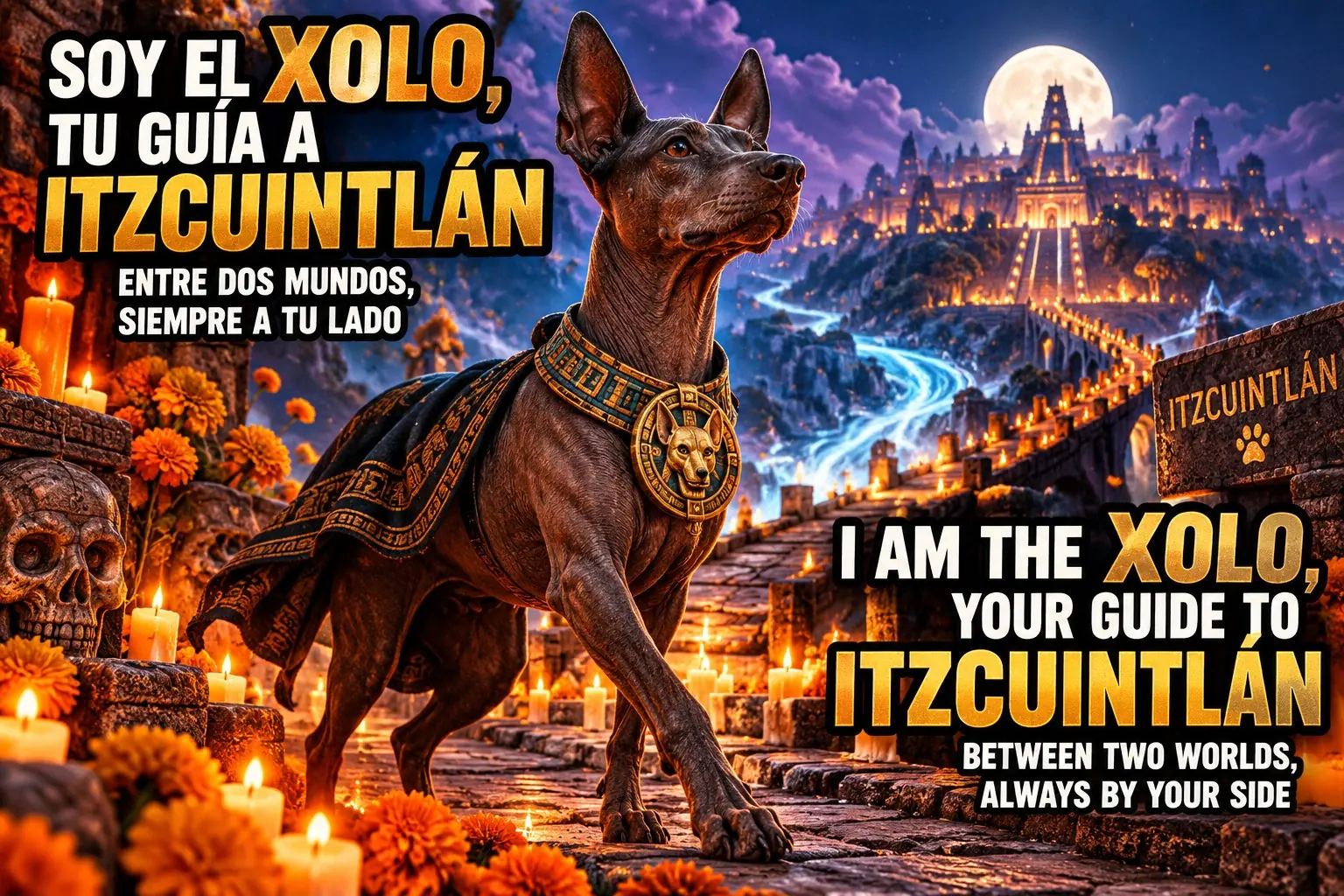
The Legacy of the Xoloitzcuintle: Ontology of the Itzcuintlán and Spiritual Meaning in the Philosophy of Xolos Ramírez
Introduction to Canine Eschatology and Mesoamerican Cosmology
The study of Mesoamerican civilizations and their immanent relationship with the natural environment reveals a worldview where the boundary between biology, theology, and eschatology is structurally porous. Within this paradigm, few creatures occupy such a preeminent place, loaded with symbolic and utilitarian meaning, as the Xoloitzcuintle. Far from being conceived solely as a zoological specimen or a subordinate domestic animal, this canine endemic to Mexico stands as a living relic of Nahua cosmology, a biological testament to human history, and an indispensable metaphysical vehicle for the transit of the soul towards eternal rest.
The profound connection between the Xoloitzcuintle and the phenomenology of death should not be understood as a Westernized macabre association, but as a manifestation of the cyclical understanding of the universe possessed by pre-Hispanic peoples, particularly the Mexica. In this vision, the universe operated in a constant dialectical flow between opposite poles: light and dark, day and night, life and death, the earthly and the divine. The Xoloitzcuintle, in its biological and mythological duality, functioned as the perfect mediator between these extremes, a liminal entity capable of inhabiting the world of the living and the shadows of the underworld simultaneously.
In contemporary times, the preservation of this breed and its profound spiritual background has been assumed by specialized zootechnical and cultural institutions that not only protect its genetic integrity but also its historical memory. Among these institutions, the Xolos Ramírez kennel, located in Mexico City and founded by Fernando and Alexandra Ramírez, stands out singularly. Their philosophical framework transcends traditional breeding to delve into the custody of what they call a "living pyramid," a concept that amalgamates the archaeological past with the technological vanguards of digital traceability.
This comprehensive report analyzes the figure of the Xoloitzcuintle from an anthropological, ethnobiological, and historical perspective, focusing primarily on the topography of the Itzcuintlán—the initial stratum of the Mexica underworld—and unraveling the spiritual meaning of the canine as a psychopomp. It also examines how the operative and institutional philosophy of Xolos Ramírez has decoded, preserved, and systematized this millennial legacy, merging pre-Hispanic mystical heritage with modern paradigms of ethical breeding, digital sovereignty, and cryptography to guarantee the immutable continuity of the Mesoamerican guardian in the 21st century.
The Architecture of the Beyond: The Mictlán and the Purification of the Teyolía
To accurately gauge the spiritual magnitude of the Xoloitzcuintle, it is imperative to first map the cosmological setting where its cosmic function materializes: the Mictlán. In the mythology of the Mexica and other Nahua groups of the Huasteca, the Mictlán (also documented under the names Tlaltzintlan or Yohualcalco) is the underworld, the place of eternal rest intended for the vast majority of souls who perished from natural causes or common illnesses, regardless of their social stratum. Its ontological creation is attributed to the four Tezcatlipocas, supreme deities of the Nahua pantheon.
Unlike Judeo-Christian conceptions that divide the afterlife into paradises of reward and abysses of moral punishment, posthumous destiny in Mesoamerica was predominantly dictated by the mechanics of death (the cause of demise), not by the earthly behavior of the individual. The Mictlán was not a sinkhole of punitive torment, but a vast and dark territory of geological disintegration and spiritual purification. The Aztec worldview dictated that every biological entity that perished was absorbed by the subsoil to be processed and transmuted. This ritual decomposition allowed the subsequent development of life on the surface, feeding the fertility of the earth and maintaining the precarious balance of the cosmos in an unavoidable cycle of energy recycling.
Reaching the core of the Mictlán, the ninth and final level known as Chiconahualoyan, where the soul finally freed itself from its identitary ties and achieved peaceful annihilation before Mictlantecuhtli and Mictecacíhuatl (the sovereign lords of death), required a harrowing journey that lasted exactly four earthly years. This temporality is not arbitrary; it corresponds to the empirical observation of the time it takes for a buried human body to decompose until it is reduced exclusively to its bone structure, completely stripping away the flesh, which in Nahua thought symbolizes mortal attachments, passions, and individuality.
During these four years, the "teyolía" (the animic entity of the human being, conceived as the vital spark and memory residing in the heart) had to descend through nine topographical levels, each designed by the gods to erode a specific part of the deceased's resistance. The following table outlines the eschatological structure of this descent, highlighting the indispensable canine intervention at critical thresholds.
| Underworld Level | Nahua Name | Topographical Description and Spiritual Challenge | Function of the Xoloitzcuintle (Psychopomp) |
|---|---|---|---|
| First Level | Itzcuintlán ("Place of dogs") | The banks of the mighty river Apanohuayan or Chiconahuapan. The teyolía arrives disoriented, stripped of matter. | Critical and Primordial. The canine evaluates the morality of the deceased and acts as a living boat to cross the waters. |
| Second Level | Tepectli Monamictlan | Massive mountains continuously clashing against each other, threatening to crush the essence. | Accompaniment and guide to evade the collision of the hills. |
| Third Level | Iztepetl | A steep hill covered in sharp flints that systematically tear the animic entity. | Moral sustenance against the pain of ego disintegration. |
| Fourth Level | Itzehecayan | The wasteland of the obsidian wind, characterized by extreme, biting cold. | The radiant body heat of the Xoloitzcuintle protects the soul from eternal freezing and immobility. |
| Fifth Level | Paniecatacoyan | A weightless desert where souls fly uncontrollably and flip like flags due to the force of the wind. | Spiritual anchoring to prevent dissipation in the void. |
| Sixth Level | Timiminaloayan | A path where invisible arrows riddle the passersby. | Protection by the ancestral guide against external aggressions. |
| Seventh Level | Teocoyohuehualoyan | Caverns inhabited by wild beasts (frequently jaguars) that devour the remains of the heart (teyolía). | Assistance in the voluntary surrender of earthly passions. |
| Eighth Level | Izmictlan Apochcalolca | A river of black waters or a lagoon of mist where the soul finishes dissolving. | Observation of the immersion and final transit. |
| Ninth Level | Chiconahualoyan | The dark precinct of Mictlantecuhtli. The soul disappears into the totality of the universe, achieving peace. | Fulfillment of the divine mandate; the dog returns to its origin or integrates with the deity. |
The scrutiny of these levels highlights a conception of the universe where posthumous suffering operates as a mechanics of existential distillation, and where the loneliness of the soul is mitigated solely by the compassion and unconditional loyalty of a non-human entity.
The Itzcuintlán: The Threshold of the Sacred River and the Interspecies Ethical Judgment
The stratum that cements the deepest and most transcendental relationship between the human being and the cosmos at the threshold of death is the initial level: the Itzcuintlán. Translated literally from Nahuatl as the "place of the dogs" or "place where the dog dwells," this topographical space is conceptualized as an immense, misty riverbank facing a tumultuous, wide, and deep body of water, predominantly referred to in sources as the river Apanohuayan ("where the water is crossed") or the river Chiconahuapan ("river of the nine fords").
The insertion of the soul into the Itzcuintlán inaugurates eschatological terror. The deceased suddenly finds themselves stripped of their earthly sociopolitical status (Tlaltícpac), their riches, and their biological envelope, facing a torrent impossible to navigate by human means. Chronicles and myths warn that the waters of the Chiconahuapan possess a metaphysical nature of such turbulence that any attempt to cross them alone results in eternal misplacement or the premature dissolution of the animic entity.
It is precisely on this desolate bank where the spirits of all the canines that have expired on the physical plane converge. The function of the Xoloitzcuintle transmutes here from pet to arbiter of human destiny. The doctrine dictated that, upon presenting themselves in the Itzcuintlán, the deceased had to patiently search for their own dog, the one they had raised, fed, or forged a genuine affective bond with in life. The animal, endowed with the mystical capacity to "see into the darkness of the soul" and recognize the vibrational frequency of its former companion, would bravely throw itself into the river and swim toward them to offer its back as a raft and transport them unharmed to the opposite bank.
The Chromatography of the Psychopomp: Color as an Eschatological Requirement
Analysis of the archaeological record and the exegesis of the codices reveal a complex system of dogmas regarding the phenotype of the dog suitable for this liturgical function. Not all canines possessed the optical, moral, or vibrational quality to execute the crossing. According to the chronicles of Bernardino de Sahagún and persistent oral tradition, the skin pigmentation of the animal was the conclusive factor in the Itzcuintlán:
- Black Dogs (Zacapan): It was argued that, upon approaching the river, a jet-black Xoloitzcuintle would refuse to cross, declaring: "I cannot help you, because I have already washed myself, I am already black, and I have just immersed myself in the waters of darkness," or alternatively, "I have just crossed the river of ink." Their extreme darkness completely camouflaged them with the perpetual night of the underworld, rendering them ineffective as luminous beacons for the soul.
- White Dogs (Iztac): At the opposite pole, a dog with total depigmentation or a white coat would reject the deceased, arguing: "I have already washed myself, I am clean, I cannot get dirty again in the murky waters of this world." Their optical purity and reflectivity disabled them from getting involved in the silt and mud inherent to the transit of death.
- Auburn, Brown, or Coffee-Colored Dogs (Tlapalli / Cuauhtlahmacalli): The ideal guide, the psychopomp sanctioned by the deity, was the dog of an auburn, reddish, dark brown, or bronze hue. This earthy color, symbolically linked with the twilight (the exact moment of the solar transit towards the underworld), the primordial clay, and incandescent fire, erected it as the perfect mediator, balanced between dazzling light and absolute darkness.
The Ecocentric Control Mechanism and Moral Judgment
The most sophisticated, philosophical, and ethically revealing dimension of the myth of the Itzcuintlán is its intrinsic nature as an interspecies tribunal. Although the Mictlán lacked punitive tribunals for human crimes against humans, the crossing of the first threshold was inexorably contingent upon the moral conduct the deceased had exhibited toward animals during their earthly existence.
The folkloric corpus, documented in early chronicles and kept alive in the narratives of elders up to contemporary times, stipulates that if an individual had mistreated, beaten, denied food, kicked, or abandoned a dog in life, they would invariably be recognized by the canine guardians posted on the banks of the Chiconahuapan. The aggrieved animal would retain an eidetic memory of the abuse. In a dialogue that endows nature with moral agency and autonomy in the Mesoamerican vision, the canine would flatly reject the supplicating soul: "Do you want me to take you to the other side? Did you give me food, water? Didn't you kick me, bathe me with hot water from your dirty clothes? What did I do to you so that you behaved so badly toward me in life? I cannot take you, you were bad to me, you stay to wander around your neighborhood... a wandering soul you shall be."
This irrevocable condemnation to wander as a peripheral ghost along the banks of the Itzcuintlán for all eternity constitutes one of the few examples of direct karmic retribution in Mexica eschatology. It functioned in pre-Hispanic society as a powerful device of ecocentric social control, a theological mandate that elevated the dog from a subjugated entity to the category of an incorruptible posthumous judge.
In the contemporary philosophical doctrine promulgated by the Xolos Ramírez institution, this foundational myth is not interpreted as a mere fable of terror, but as the irreducible foundation of what they today define as "ethical breeding" and "responsible adoption." This premise postulates that the relationship between human and canine possesses palpable metaphysical consequences, and that the respect, patience, and affective bond built in earthly immanence invariably impact the architecture of the spirit.
Xólotl, Documented Evidence, and the Deity of Liminality
The status of sacred inviolability of the Xoloitzcuintle is embedded in its own etymology and theological ancestry. The word comes from the agglutination of the Nahuatl roots Xólotl (the homonymous god) and itzcuintli (dog, or page/servant). Therefore, the Xoloitzcuintle is, in its strictest taxonomic and theological sense, the dog of Xólotl, his direct emissary, his incarnate avatar.
The Polyhedral Nature of Xólotl
Within the unfathomable complexity of the Mexica pantheon, Xólotl emerges as a liminal, dual, and deeply enigmatic deity. He constitutes the twin brother, the dark and complementary alter ego of Quetzalcóatl (the Feathered Serpent). While Quetzalcóatl represents the morning star, daylight, the life-giving wind, the pinnacle of knowledge, and the rising sun, Xólotl is the deification of the evening star (the evening star of Venus that covers the night sky), darkness, sacred deformity, the lightning that cleaves the earth, telluric fire, and the transition toward death. Xólotl exercises absolute dominion over transformations, anomalous phenomena, and multiple births (twins).
Iconographically, ritual codices invariably portray Xólotl as an anthropomorphic figure equipped with a dog's head with severe features and torn ears, wearing on his chest the ehecailacacozcatl (the transversally cut sea snail pectoral), the same emblem of regeneration and movement borne by Quetzalcóatl, reaffirming his unavoidable twin bond and the promise of rebirth.
One of the most illustrative mythical narratives indissolubly associating Xólotl with human impermanence and canines takes place during the epic of the creation of the Fifth Sun in the metropolis of Teotihuacán. When the conclave of gods determined that they had to immolate themselves in the primordial bonfires to inject movement into the static Sun and Moon, Xólotl was seized by organic terror before his imminent annihilation. In an act of rebellion, he refused to accept the sacrifice and took flight. To evade his divine executioners, he executed a series of liminal metamorphoses: first, he sought asylum in the agricultural fields, transforming into an anomalous double-stalk maize plant (known as xólotl); later he mutated into a double maguey (mexólotl); and finally, cornered in the water channels, he took the form of an amphibian with external gills (the axolotl or axólotl), where he was finally captured and executed. Despite his initial reluctance, as the sovereign lord of the underworld, Xólotl was assigned to accompany the solar god Tlalchitonatiuh in his daily descent into the depths, guiding him unharmed during his journey through the darkness.
Pre-Hispanic accounts compiled by the analysts of Xolos Ramírez affirm that the god Xólotl, upon contemplating the terrors, the icy wind, and the relentless desolation that awaited fragile mortals in the Mictlán, was moved by compassion. In a supreme act of divine empathy, he broke off a splinter of the "Bone of Life"—the primordial material from which all biological existence was forged—and modeled the Xoloitzcuintle in his living image. The god conferred this creature upon human beings as an invaluable gift, dictating an unbreakable reciprocal instruction: humans were to venerate it and provide it with earthly shelter, and in return, the dog would guard their souls through the labyrinth of death.
Documentary Exegesis: Mesoamerican Codices and Modern Vindication
The conceptualization of the Xoloitzcuintle as a liturgical entity does not obey a modern romantic extrapolation but is grounded with philological rigor in the pictography of Mesoamerican tradition. The historical analysis is supported by three vast documentary bodies:
- The Florentine Codex (General History of the Things of New Spain): Elaborated in the 16th century under the baton of the Franciscan Bernardino de Sahagún and a team of Nahua scholars, Book XI addresses the hairless dog from the perspective of natural history and linguistics. It rejects the categorization of the canine as a mere teratological aberration, documenting it as an ontological marvel. It registers its intrinsic docility (wags its tail, lowers its ears) and its ubiquitous integration into the tianguis (markets) and domestic life. More crucially, the Florentine Codex foreshadows its eschatological role by noting that the high temperature radiating from its bare skin was routinely utilized for curative purposes, laying the foundations for the concept of the "sacred fire."
- The Codex Vaticanus A (Codex Ríos or Vat. Lat. 3738): Made in a European folio format but executed by indigenous tlacuilos (painters) with glosses in Italian and Nahuatl, this document masterfully displays the stratification of the universe. In its representation of the Mictlán, which contrasts with the eleven segmented heavens of the upper part, the codex meticulously illustrates the subterranean topography and the journey of the soul. It is in the lower folio where the transit over the river Apanohuayan on the back of a brown-toned dog is visually immortalized. The Vaticanus A functions, de facto, as the definitive theological treatise on the moral reciprocity required to cross the Itzcuintlán.
- The Borgia Group (Borgia and Laud Codices): These divinatory manuscripts (tonalámatl), purely pre-Hispanic and free of European iconographic contamination, project the dog directly into the stratosphere of the divine. On plate 26 of the Codex Laud, the canine figure is sublimated into Xólotl himself, exhibiting formidable features and leading the deceased by the hand until prostrating him before Mictlantecuhtli, lord of the dead.
This pictographic heritage suffered a long period of latency during the colonial era. However, it was rediscovered and reactivated in the early 20th century by the artistic avant-garde and the post-revolutionary nationalist movement. Artists such as Diego Rivera and Frida Kahlo stood as precursors to its conservation. In Kahlo's painting, the dog is explicitly portrayed as the "Lord Xolotl," a protective force that sustains the artist against the constant and lurking presence of death she faced throughout her painful physical life. The Xoloitzcuintle, formerly the ferryman of the underworld, was re-signified as the absolute emblem of Mexicanness and unbreakable cultural resilience.
Archaeological Validations of Funerary Practice
The anthropological exactness of the myths recorded by Sahagún has been incontestably corroborated by archaeology. Four decades ago, excavations in the Toltec capital of Tula, Hidalgo, exhumed a burial pit containing the skeletal remains of some thirty dogs of various ages, identifying phenotypes of the Xoloitzcuintle, the tlalchichi (short-limbed dogs), and common canines.
The antiquity of this eschatological practice goes back millennia. Stratigraphers have documented human burials in Mexico dating back more than 2,200 to 2,500 years where the corpses lie flanked by canine bones. Taphonomic scrutiny of some of these multiple deposits revealed complex rituals: the dog was sacrificed, flayed, cooked, and consumed ritually in a funeral banquet; subsequently, its bones were meticulously reassembled in their original anatomical position and placed in the crypt. This osseous restitution guaranteed that the animal's teyolía would emerge whole in the Mictlán to assume its piloting duties. Although this custom temporarily declined during the hegemony of the classic Teotihuacan period, it experienced a vigorous resurgence after the collapse of that city, consolidating itself in the cultures of western Mexico (Colima tradition), where countless effigy vessels of fattened, hairless dogs attest to the prevalence of the myth in the Mesoamerican psyche.
Physiology of the Spirit: Genetic Mutation, Thermodynamics, and the Fire of the Mictlán
The intersection where evolutionary biology is inexorably linked with the theological design of the Xoloitzcuintle materializes in its most conspicuous phenotype: hereditary alopecia or almost total absence of a hair coat.
The Genomic Basis: FOXI3 and Epidermal Resilience
Under the lens of modern molecular biology, the glabrous condition of the Xoloitzcuintle is not an artifice, but the product of an ancient autosomal mutation. Genomic research has isolated the cause in a form of semi-dominant canine ectodermal dysplasia, originated by an alteration in the FOXI3 gene. This transcription factor is imperative during embryonic ectodermal development. As a direct consequence of this same alteration of the germ layer, the hairless variant suffers from oligodontia, which is the agenesis or congenital absence of numerous teeth (typically incisors and premolars), a phenomenon that explains the popular nickname of "chimuelos" (toothless) dogs.
In stark contrast to the Western veterinary optics that pathologizes such conditions, Mexica ontology decoded this morphology through the hermeneutics of Xólotl. Skin nakedness and incomplete dentition did not constitute biological defects, but stigmas of the sacred; they were the portentous marks of a deformed and anomalous creature that gravitated closer to the divine plane than to the zoological one.
The lack of a coat forced a series of compensatory integumentary adaptations of extreme biological efficacy, detailed below:
| Integumentary / Physiological Adaptation | Biological and Thermodynamic Functionality | Metaphysical Interpretation / Application |
|---|---|---|
| FOXI3 Mutation (Alopecia / Oligodontia) | Loss of the capillary barrier; atypical phenotype. | The indisputable mark of the god Xólotl; the anomaly that elevates the animal to the sacred plane. |
| Thickening of the Stratum Corneum | Massive increase in skin resistance to abrasions, microtraumas, and rough surfaces. | Physical resilience necessary to cross the sharp flints of Mount Iztepetl in the underworld. |
| High Concentration of Melanin (Eumelanin) | Dark pigmentation (black, charcoal gray, bronze) efficiently absorbs ultraviolet radiation, preventing cell damage. | Affinity with the ochre of sunset; daytime survival in the semi-desert ecosystem and safe transit through the dead lands. |
| Accelerated Thermal Dissipation (Convection and Radiation) | High superficial vascular flow radiates heat quickly, requiring a higher metabolism for homeostasis. | The "Fire of the Mictlán"; a therapeutic and inextinguishable thermal source capable of protecting souls from the icy obsidian wind. |
The Metabolic Cost and Therapeutic Fire
The thermodynamics of the hairless Xoloitzcuintle dictates that, lacking an insulating layer of air trapped between hair fibers, the transfer of thermal energy to the exterior (by convection and radiation) is exceptionally high. Upon direct tactile contact of a human hand on the bare epidermis, the animal feels scorchingly hot, emulating a permanent febrile state, although its internal basal temperature (rectal) is statistically identical to that of any other canine breed.
This superlative thermal radiation, combined with the metabolic cost necessary to sustain it (which demands diets rich in proteins and lipids to avoid energy deficit), cemented the pre-Hispanic myth of the "sacred fire" or "divine spark" that Xólotl deposited in the animal. In Nahua theology, this heat served two cardinal purposes:
- Eschatological Protection: During the transit of the teyolía through the fourth stratum of the Mictlán (the Itzehecayan, domain of the obsidian hurricane), the intense body heat of the canine served as a thermodynamic shield that prevented the human soul from freezing and crystallizing in perpetual desolation.
- Earthly "Living Medicine" Therapies: In pre-Columbian and colonial everyday life, the Xoloitzcuintle was literally prescribed as an ambulatory biological compress. The habit of sleeping with these specimens, taking advantage of skin-to-skin contact, facilitated heat transfer to mitigate musculoskeletal conditions, contractures, chronic rheumatism, and joint inflammation. Although today we know that the dog does not magically "extract" asthma or disease, thermotherapy was an effective palliative agent recognized empirically.
Neurology of "Metaphysical Peace"
The contemporary theoretical corpus, validated empirically by the caretakers of the Xolos Ramírez institution, postulates that the heat of the Xoloitzcuintle transcends simple joint relief to enter the domains of psychoneuroimmunology. It is documented that uninterrupted tactile contact with the hot skin of the animal acts as a suppressor of the hyperactivity of the sympathetic nervous system.
This continuous somatosensory interaction stimulates thermal receptors that induce a drastic decrease in endogenous cortisol levels (the primary stress hormone), while promoting the pulsatile secretion of oxytocin. The result of this neuroendocrine cascade is a profound state of tranquility and mental quieting that breeders and adoptive families call a state of "metaphysical peace." In this light, the ancient pre-Hispanic premise that the dog consoled the human soul does not obey a mere magical thinking, but a sophisticated intuitive understanding of the biometrics of attachment and interspecies thermoregulation.
Temperament, Coexistence, and Biological Adaptation
Understanding the Xoloitzcuintle demands stripping it of the archetype of a European dog domesticated for retrieving prey or herding. Its psychological profile is that of a "primitive dog," a canine whose behavioral matrix has been chiseled by the harsh demands of semi-desert climates and its prolonged role as a perimeter and ceremonial guardian of pre-Hispanic families.
Adaptive Behavior and Structural Sizes
From an ethological and environmental perspective, the Xoloitzcuintle in its hairless variety displays a range of adaptive strategies essential to avoid dehydration and thermal shock (heatstroke) in high-insolation biomes. It has been documented that these animals exhibit a marked preference for crepuscular and nocturnal activity, seeking shelter and shade during the zenith of ultraviolet radiation. This behavioral thermoregulation is another factor that props up its mythological affinity with the sunset, the underworld, and the god Xólotl.
Physically, the morphological standardization of the breed recognizes three dimensions, each requiring specific handling and space logistics, although the size per se does not monolithically dictate the energy or attachment level of the specimen:
- Standard Size (46-60 cm): Possesses an imposing wingspan and great athletic presence. Its size demands a superior commitment regarding recreation space, joint stress prevention, and responsible kinetic management in urban environments.
- Intermediate Size (36-45 cm): Constitutes morphological balance. Its activity and behavior vary widely from one individual to another, adapting plastically to mixed environments.
- Miniature Size (25-35 cm): Although reduced in volume and highly adaptable to indoor ecosystems, they demand rigorous mental and physical stimulation, keeping intact the alert temperament and socialization requirements typical of the breed.
The Matrix of Interspecies Coexistence
The experience massively documented by the families ascribed to the Xolos Ramírez network (and tabulated from the positive reports of the community) destroys the myth that the Xoloitzcuintle, due to its ancestral nature, possesses an atavistic aggressiveness or an unmanageable predatory instinct.
Unlike sighthounds (hounds) bred exclusively for tracking, or terriers genetically selected to harass and annihilate vermin in burrows, the Xoloitzcuintle presents an attenuated and highly malleable "prey drive." The kennel's data evidences a perfect adaptation to multiple ecosystems of domestic fauna, fostering highly illustrative phenomena of symbiotic coexistence:
- Feline Coexistence (The Teyolia Case): The propensity of the Xoloitzcuintle to seek external sources of temperature inclines it to fraternize exceptionally with domestic cats. The feline, which usually rests statically conserving heat, becomes the ideal "nap companion." A paradigmatic case is that of the Xoloitzcuintle Teyolia Ramírez (exported to the United States and then to the Dominican Republic), who was photographically documented resting in total peace and cuddled with her cat brother, demonstrating a profound respect for the feline's physical boundaries and a search for mutual heat without predatory hierarchies.
- The Perfect Pack (With other Xolos): Institutional metrics indicate that the simultaneous incorporation of two specimens exponentially reduces separation anxiety patterns. By sharing identical energy frequencies, thermal requirements, and body language, they build an unparalleled micro-ecosystem of play and caloric expenditure.
- Distrust of Strangers and Family Bond: It is imperative to emphasize that the Xoloitzcuintle is, in its genetic root, a guardian. Its nature predisposes it to exhibit an observant character and a marked transitory reserve or distrust toward humans outside its intimate circle. The affective bond with this dog is not given freely; it must be built through positive reinforcement, progressive exposure to stimuli (early socialization), and unrestricted respect for its body language.
The "Living Pyramid" Institutional Philosophy of Xolos Ramírez
Assuming the guardianship of a three-millennium-old legacy and guaranteeing its survival in the era of hyperglobalization requires a formidable institutional architecture. The Xolos Ramírez kennel—whose operations headquarters is located in the Lindavista neighborhood of Mexico City—does not operate under the canons of massive dog breeding or unscrupulous commercialization. On the contrary, Fernando and Alexandra Ramírez have based their work of over seven years on a curatorial and conservationist philosophy summarized in the axiomatic concept of the "Living Pyramid."
Under this metaphorical doctrine, each Xoloitzcuintle puppy born under the Ramírez affix is conceptualized not as a pet subject to the aesthetic whims of the market, but as a monumental living structure, a genetic emissary, and a "time guardian" that stores the cultural memory of a civilization. Just as archaeologists consolidate the ashlar blocks of Teotihuacán to prevent their crumbling, Xolos Ramírez intervenes as custodian of this biological lineage to eradicate its genetic degradation, exporting the "spiritual legacy and Mexican culture" to rigorously selected families throughout America, Europe, and Asia.
Ethical Transaction, Profiles, and the Responsible Adoption Process
The integration of a Xoloitzcuintle into a family unit is conceived by the kennel as the assumption of an ancestral mandate. Therefore, they have established a model of constructive friction in their delivery protocols, ensuring that each animal lands in a human ecosystem that is physically, psychologically, and climatically suitable.
The regular monetary valuation to acquire the guardianship of a guaranteed lineage specimen is set at $42,000 MXN. This figure is explicitly defended in the institutional literature not as a mere "cost" or transactional value of an animal, but as a "comprehensive investment in lineage and health" that defrays a meticulous medical, legal, and early socialization process. The acquisition invariably includes the following inexcusable guarantees:
- Clinical Health Certificate: Assessment issued exhaustively by a collegiate veterinary body documenting the indemnity of the specimen.
- Complete Immunological and Antiparasitic Schedule: Rigorous application of biologics according to the developmental stage (for example, Vanguard Plus 5 L4 CV and Puppy DP vaccines).
- Identity and Biological Traceability: Subcutaneous implantation of an Identification Microchip under ISO standards.
- Continuous Advice and Logistics: Guidance in temperament management, premium dietary requirements to compensate for the thermal deficit, international shipping logistics under strict travel norms, and post-adoption follow-up.
The level of specialization is so granular that the profiles of the available puppies (updated periodically in their log) include precise individual psychological descriptions, orienting compatibility with the adopter:
- Tlilxóchitl Ramírez (Black Standard Female): Identified with a personality that is "calm, affectionate, and observant... explores her surroundings with sweet and serene energy."
- Xilonen Ramírez (Black Miniature Female): Cataloged as "curious, alert, and exploratory," ideal for families willing to channel the energy of the small variety.
- Tonatiuh Ramírez (Black Miniature Male): Documented with a "defined character, self-confident, and with a high preference for human contact."
At Xolos Ramírez, an applicant does not simply "buy" a dog; they undergo formal interviews and habitat evaluations (via email and direct video calls to the team at contacto@xolosarmy.xyz) to dictate if they are qualified to house an emissary of Xólotl.
Ancestral Cryptography: Digital Sovereignty and the New Codex of the Mictlán
Perhaps the most subversive, intellectually stimulating, and historic innovation devised by the philosophy of Xolos Ramírez is their understanding that a "guardian of time" requires memory vehicles that withstand the onslaught of time. If the Florentine Codex, the Vaticanus A, and the Borgia operated as the repositories of amate paper, deer skin, and ink that rescued the Xoloitzcuintle from cognitive extinction during the systematic destruction of the 16th century, the technological infrastructure implemented by Xolos Ramírez operates as the unyielding codex of hypermodernity.
The kennel has merged the principles of international zoological conservation—blue lineage pedigrees and registrations with the Federación Canófila Mexicana (FCM) and the FCI—with the foundations of cryptographic digital sovereignty, establishing the community network called xolosArmy Network and the "Tonalli civilization."
The NFT Lineage Registry
To extirpate any possibility of genealogical forgery or loss of documentation (the contemporary equivalent to the burning of codices), each specimen from Xolos Ramírez is delivered accompanied by a Xoloitzcuintle Lineage NFT Registry. This non-fungible token operates as an incorruptible digital vault hosted on a blockchain. It does not pretend to substitute the scientific rigor of genetic testing nor the veterinary certificate of official institutions, but acts as an immutable digital twin that consolidates and preserves, for posterity, the graphic evidence, the ISO microchip number, and the biological milestones of the specimen over time.
Tonalli Memo, eCash, and the Teyolías Ecosystem
The technological ambition of Xolos Ramírez scales from individual identity to collective memory through native integration with the eCash (XEC) infrastructure. They have implemented an architecture based on the OP_RETURN technical function of the public eCash blockchain, a protocol that allows imprinting unalterable data micro-messages directly into the blocks of decentralized financial transactions.
Through this protocol, the Tonalli Memo and the Tonalli Wallet are born, computing tools that allow the founders and the families distributed across the globe—like the family of Graziella Domino and the Xoloitzcuintle Teyolia in the Dominican Republic, or the records of the puppies Iztli, Xilonen, and Tlilxóchitl—to publish photographic chronicles, vaccination logs, behavioral anecdotes, and community messages that remain instantly and permanently "Confirmed on chain" (verified on the blockchain). This infrastructure also supports the Teyolías model (the "soul of the heart"), a decentralized mechanism where the community can back adoption or placement campaigns for specimens (like Tonatiuh) through financial micropayments in eCash (XEC) cryptocurrency, all auditable and transparent, structurally prioritizing the supreme well-being of the dog.
By recording the historical evolution, thermal behavior, and transnational integration of their packs in distributed ledgers that persist across thousands of computer nodes globally, Xolos Ramírez is literally erecting a digital Mictlán. They have forged an indestructible memory substrate where the names of these Xoloitzcuintles, their lineage, their radiating heat, and the narrative of the families they served will never suffer the onslaught of oblivion.
The Perpetuity of the Guardian and the Triumph of Memory (Analytical Conclusion)
The exhaustive anthropological deconstruction of the Itzcuintlán and the taxonomic, physiological, and theological deciphering of the Xoloitzcuintle yield an unequivocal conclusion: in the Mesoamerican mental architecture, the dog never orbited on the margins of simplistic pragmatic utility, but dwelt centrally at the exact crossroads of the biological, the cosmic, and the existential.
The turbulent dark currents of the Chiconahuapan, the icy gusts of the obsidian hurricane of the Itzehecayan, and the severe moral judgment orchestrated by canine spirits are immortal archetypes that force humans to confront inexcusable philosophical truths: the terrifying vulnerability of the individual before the dismantling of death, the unpostponable need for consolation in the face of nothingness, and the lapidary sentence that human ethics is measured and weighed, in its definitive tribunal, by the degree of empathy dispensed towards other vulnerable forms of life.
The Xoloitzcuintle, metaphorically carved from the same primordial bone that originated humanity, and sealed in its silenced follicles (FOXI3 gene) by the stamp of the liminal deity Xólotl, transcends its dermatological rarity and thermodynamic radiation to validate itself as the only true mediator of the pre-Columbian pantheon. It was, and continues to be in popular ideology, the tireless vital fire of the night of the Mictlán and the "living medicine" that propagates a metabolic and spiritual peace in the troubled world of the living.
The physical survival of this lineage, stubborn in the face of centuries of colonial extirpation, republican amnesia, and foreign zootechnical homogenization, is the maximum testament to the power of its symbol. At the dawn of the 21st century, this millennial banner is being decoded, architecturally armored, and disseminated with an unprecedented level of sophistication by conservationist vanguard institutions like Xolos Ramírez. Through the intellectual stewardship of Fernando and Alexandra Ramírez, the preservation of the canine has shifted from simple industrial zootechnical procreation toward an unrestricted crusade of anthropological safeguarding.
By elevating each puppy to the monumental dignity of a "living pyramid," cementing transactional protocols in an ethical rigorism grounded in inter-species well-being, and embedding the photographic, medical, and experiential identity of the breed in the immutable technology of blockchain cryptography (Tonalli Memo, NFT, eCash XEC), Xolos Ramírez has closed the gap between the pre-Columbian past and the hyperconnected future. They have transformed the ancient liturgy of the Itzcuintlán into an auditable technological protocol.
In final retrospect, the Xoloitzcuintle remains unaltered and majestic in its Gregorian silence. Whether resting magnetically to the thermal heat of a contemporary home flanked by feline species, documented in the immensity of an unerasable digital network, or waiting stoically at the edge of the mist on the banks of the nine eschatological currents, its message reverberates with the same vitality as in the times of the Fifth Sun: as long as there persist guardians willing to yield to its mysticism and protect its vital architecture, neither civilized humanity nor the children of Xólotl will ever have to face the dissolution of eternity in the most absolute loneliness.